
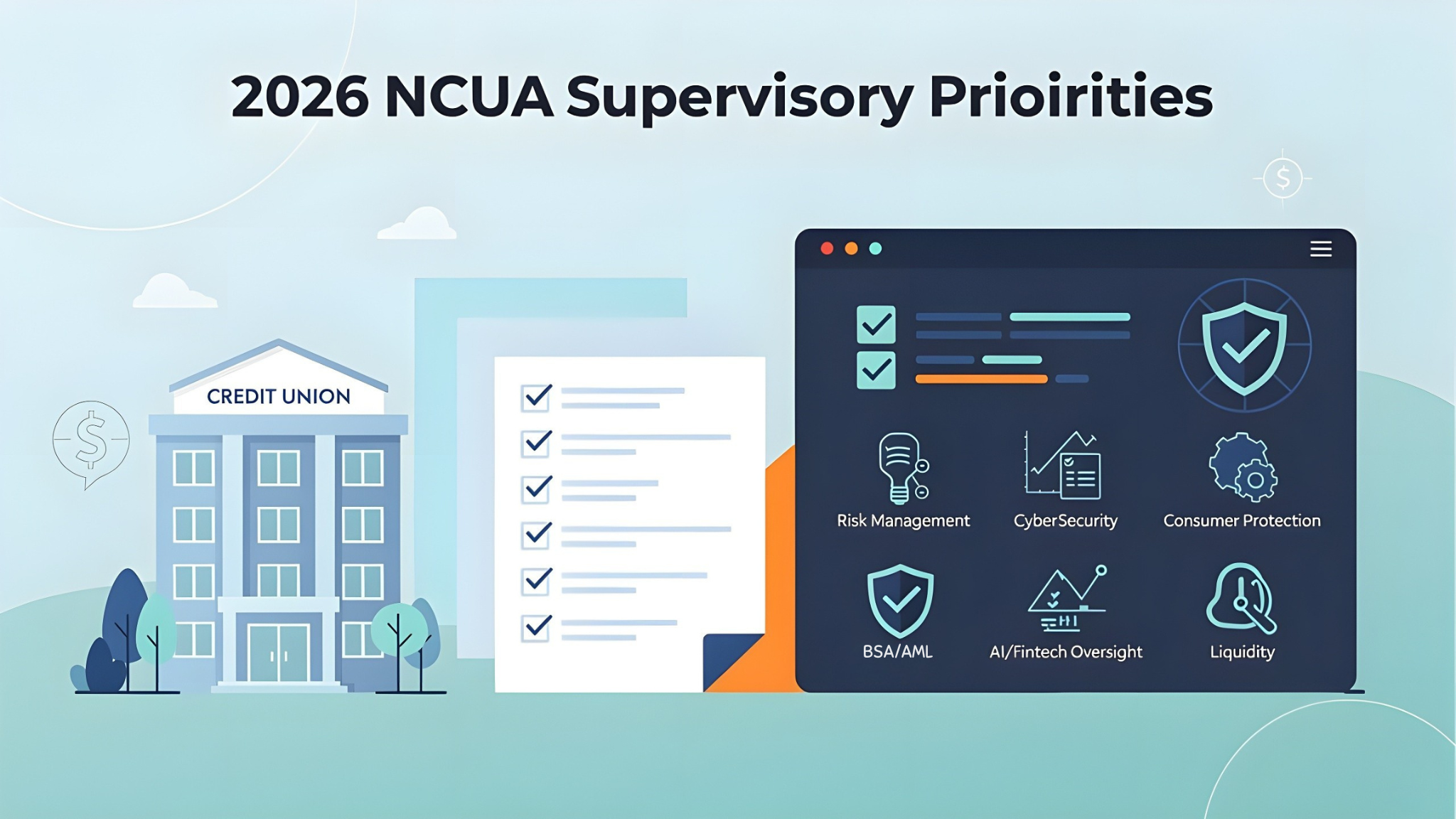
Each year, the NCUA releases its supervisory priorities to give credit unions a heads-up on what examiners will focus on during exams. The 2026 letter is out, and while some themes are familiar, there are a few shifts worth noting.
If you haven't seen the letter yet, here's what matters most for audit teams preparing for exams this year.
Balance Sheet Management Takes Center Stage
Lending and Credit Risk
Loan performance has been sliding for a while now, and it's finally caught the NCUA's full attention. Delinquency rates and 12-month loss rates are at their highest point in over a decade. For credit unions dealing with expensive funding sources like share certificates and borrowings, this is creating real balance sheet pressure.
Examiners will dig into credit administration practices, including:
- Loan underwriting standards
- Loss mitigation programs (modifications, workouts)
- Allowance for Credit Loss (ACL) reserves and methodologies
- Charge-off practices
- Portfolio monitoring, especially for concentration risks
- Third-party risk management (if you outsource lending, servicing, or collections)
The message is clear: if your asset quality is deteriorating and you're relying on high-cost funding, expect questions about how you're managing the situation.
Interest Rate Risk and Liquidity
Interest rate risk and liquidity remain top priorities, but the tone has shifted slightly. While rates have started to decline, many loans and funding costs haven't fully repriced yet. That means pressure on earnings and balance sheets continues, even if it's less intense than it was at peak rates.
The NCUA is concerned about credit unions that expanded their balance sheets during the low-rate environment and are now dealing with repricing challenges. Replacing defaulted or lower-yielding assets has become harder, pushing credit unions toward higher-yielding loans—which, naturally, come with more risk.
Examiners will focus on:
- How you model and measure interest rate and liquidity risks
- Whether your assumptions are reasonable and your scenarios are appropriately tiered
- How these risks are incorporated into governance, contingency funding plans, and strategic decisions
- Alignment between balance sheet structure, funding composition, and risk appetite
If you're relying on diversified funding strategies and robust liquidity risk management, make sure your documentation reflects that.
Earnings and Capital Adequacy
Earnings pressure isn't going away. Asset quality issues and elevated allowance expenses are dragging down profitability, while high funding costs are limiting margin recovery and capital accumulation. Regulatory capital ratios (measured by net worth) have improved for many credit unions, but earnings haven't kept pace.
There's also the matter of unrealized losses on long-duration securities that credit unions bought during the low-rate era. Those losses are still sitting on balance sheets, limiting flexibility under stress.
Examiners will assess whether your earnings are sufficient to support capital targets across various stress scenarios—interest rate changes, credit deterioration, liquidity constraints, and concentration risks. Expect them to review:
- Policies, procedures, and risk limits
- Capital planning practices
- Forward-looking analysis aligned with your credit union's size, complexity, and risk profile
The NCUA wants to see that you're thinking ahead, not just reacting to current conditions.
Operational Risk Management
Payment Systems
Consumer expectations around payments keep evolving, and credit unions are adapting (sometimes faster than their risk management frameworks can keep up). Payment systems now involve complex integrations of applications, security features, and internal controls. That complexity introduces operational and security risks.
Fraudulently induced payments, illicit use of consumer data, and cybersecurity breaches targeting payment systems are all growing concerns. Examiners will check whether you have effective governance, risk assessments, vendor management, and security frameworks in place to support payment operations and protect member data.
If your credit union offers faster payment options or works with fintech partners on payment services, expect questions about how you're managing those relationships and the risks they introduce.
Fraud Prevention and Detection
Fraud is still pervasive in the financial system, and the NCUA isn't letting up. Examiners will review your efforts to deter and detect fraud, including internal controls and separation of duties to guard against insider abuse.
In 2026, the NCUA is also reviewing its examination procedures to align with the evolving fraud landscape. That suggests they're adapting their approach based on what they're seeing across the industry. (Translation: they've probably noticed some new trends they don't like.)
The NCUA continues working with credit unions, regulators, and law enforcement to improve fraud prevention and detection capabilities. You can find resources on their Fraud Prevention Resources page.
Compliance Risk Management
Bank Secrecy Act (BSA) and Anti-Money Laundering (AML/CFT)
The BSA landscape is changing throughout 2026. FinCEN and the federal regulators (including the NCUA) are implementing provisions of the Anti-Money Laundering Act of 2020, which is designed to modernize and strengthen the U.S. AML/CFT regime. At the same time, they're evaluating ways to reduce BSA compliance burdens while maintaining effective, risk-based AML/CFT programs.
Expect regulatory changes this year. The NCUA will notify credit unions, but you can also sign up for FinCEN Updates to stay informed. Either way, make sure your BSA policies, procedures, internal controls, and overall AML/CFT program remain in compliance.
The emphasis in 2026 is on evaluating your risk-based approach to BSA compliance. Examiners will look at whether your AML/CFT program is tailored to your credit union's specific risk profile and whether you're focusing resources on the areas of greatest money laundering and terrorist financing risk.
What This Means for Audit Teams
The 2026 priorities don't introduce major surprises, but they clarify where the NCUA is focusing its attention. Credit unions should:
- Reassess credit risk management strategies, especially for high-delinquency loan categories
- Ensure liquidity and capital plans are well-documented and realistic under stress scenarios
- Review payment system integrations and third-party vendor risk management
- Tighten fraud detection controls and internal separation of duties
- Stay current on BSA/AML regulatory changes and ensure policies reflect the latest requirements
For most credit unions, the exam process won't look drastically different in 2026. But the pressure points are clear, and addressing them proactively will put you in a stronger position when examiners arrive.
Read the full 2026 Supervisory Priorities here: https://ncua.gov/regulation-supervision/letters-credit-unions-other-guidance/ncuas-2026-supervisory-priorities
Get a head start on preparation with our checklist here: https://www.redboard.com/credit-union-audit-checklist
 Get FREE Access to the Audit Checklist for Credit Unions!